NIH Websites Are Changing
Feedback sessions share research results, including an ‘eye-opening’ finding
March/April 2026 | Volume 25 Number 2
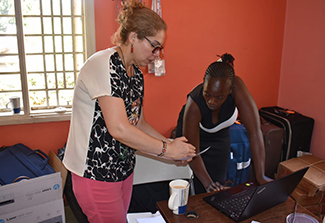 Photo courtesy of Ana Lucia Seminario
Dr. Ana Lucia Seminario (left) and Moureen Otieno (right) during study startup activities at Jaramogi Oginga Odinga Teaching & Referral Hospital in Kisumu, Kenya
Photo courtesy of Ana Lucia Seminario
Dr. Ana Lucia Seminario (left) and Moureen Otieno (right) during study startup activities at Jaramogi Oginga Odinga Teaching & Referral Hospital in Kisumu, Kenya
Research feedback sessions in Kenya spurred discussions of surprising results and unhealthy practices, say Timothy A. DeRouen Center for Oral Global Health researchers.
The team at DeRouen, which is part of the University of Washington (UW) School of Dentistry, shared their findings from a study of oral health in 3- to 4-year-old children. Jaramogi Oginga Odinga Teaching and Referral Hospital in Kisumu County, Kenya, and some of its networked health clinics served as study sites. Health staff from the hospital and clinics, including nurses, medical assistants, physicians, and the clinic director, attended the sessions. “These are the people who really made things happen,” says Principal Investigator (P.I.) Ana Lucia Seminario, DDS, PhD.
The shared findings included baseline assessments from the ongoing project, “Dynamics of HIV-infection, oral innate immunity and the development of oral diseases in children,” which is funded by Fogarty’s HIV-associated Noncommunicable Diseases research program and the National Institute of Dental and Craniofacial Research.
Surprising results
The study compares the oral health outcomes of three groups of children—those who are living with HIV, those who are HIV exposed and uninfected, and those who are unexposed and uninfected. (“Exposed and uninfected” refers to the children of HIV positive mothers who are born without the virus.) “One of the strengths of our study is that we were able to include a well-characterized and balanced cohort of children across all three groups,” says Seminario, who is director of the DeRouen Center and professor of pediatric dentistry at UW.
The team’s analysis showed that children living with HIV had more cavities and gum disease than the other two groups. By contrast, the group with the best oral health were the exposed and uninfected kids. This is an “eye-opening” finding, says Seminario.
The Kenyan team members theorize (based on their qualitative studies) that these kids do well in part because their families see them as special and so protect their health. “They call the HIV negative children born to HIV positive mothers ‘miracle babies,’” says Seminario. Also, the mothers have become very good at following instructions to avoid passing the virus onto their children. (Mothers must maintain a strict drug regimen of antiretroviral therapy (ART) to prevent transmission during pregnancy; while breastfeeding, both mother and child are on ART.) This same diligence continues after birth, explains Seminario. “They’ve been very engaged in their child’s health since before birth and they continue this after birth by taking their children to regular pediatrician checkups and being careful with their diets.”
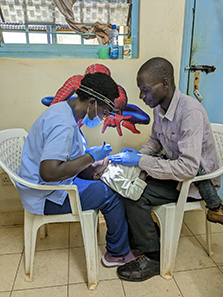 Photo courtesy of Ana Lucia Seminario
Dr. Immaculate Opondo (left) performing an oral exam in Kisumu, Kenya
Photo courtesy of Ana Lucia Seminario
Dr. Immaculate Opondo (left) performing an oral exam in Kisumu, Kenya
Unhealthy practices
During the well-attended feedback sessions, a co-P.I. on the project, Arthur Kemoli, BDS, PhD, explained the study results with assistance from the study’s coordinator, Immaculate Opondo, DDS (Maseno University). Findings show high rates of HIV-related oral health conditions like oral ulcers, candidiasis, and warts among the children living with HIV. Attendees asked how to identify caries (cavities) and oral lesions, and they also wanted to hear useful information about the effects of these HIV-related conditions.
“If you have a blister as an adult, it hurts, but blisters in 3 or 4-year-old children impact the way they eat and even drink, possibly leading to poor nutrition and so poor growth,” says Seminario.
Oral mutilation was another concerning topic for attendees. “It is believed in some rural areas that the canine teeth are somehow related to evil, so a shaman or spiritual leader will operate on children, basically opening the gums, going through the bone, and removing the canines,” says Seminario. Often, these operations are performed with unsterilized instruments, so children can develop infections and, in some cases, end up in the hospital.
Kemoli, who is the former Chair of the Department of Paediatric Dentistry and Orthodontics at the University of Nairobi, is a strong advocate against this practice. He’s gone from community to community to discuss the harms with local leaders. He and Opondo, whose PhD thesis focuses on the association between oral mutilation and HIV infection, addressed attendees’ many questions on this and related health topics.
This transition from feedback session to a wider conversation about health is natural, says Dr. Frank Roberts, PhD, Associate Dean of Regional and Global Affairs at UW School of Dentistry. Worldwide, oral diseases are more prevalent than other diseases. “Everybody has had some experience with teeth problems. Talking about dentistry can open doors and lead people to think more generally about their health.”
Evidence-based practices
The team’s ongoing analyses include testing and assessing saliva samples to better understand the oral microbiome. (The mouth harbors many microorganisms, including bacteria, fungi, viruses, and protozoa, collectively known as the microbiome.) An analysis of one salivary biomarker, a tiny protein known as LF37, which has antimicrobial properties, has recently been completed.
“The decrease of this tiny protein in the saliva precedes the development of new caries, new lesions, and that's absolutely a new finding because there has never been an opportunity to assess little kids longitudinally,” says Seminario. (Her longitudinal study examines and reexamines each child at regular intervals over time, instead of collecting data from each child just once.) This study design enables the researchers to capture more data and helps them better understand the complexities of oral health. Seminario says that kids' mouths change so much around ages 3 to 4 years old, because “first they have no teeth, then they get their first teeth, then these teeth are lost and replaced by permanent teeth—there’s a lot going on!”
Looking ahead, she believes the new data will provide the necessary evidence to sway the decision-making of pediatricians and dentists and advocates who hope to integrate oral health within HIV care. “We are over the moon because we have robust data.”
Roberts is equally excited as Seminario, still he cautions that the greater challenge here is to influence community practices. “We need to help people take a new approach to oral care that is supported by this evidence. That’s where implementation research comes into play.” Without uptake of evidence-based knowledge, the same health problems will simply continue worldwide, including in the United States, he says.
Seminario says, “Our work is helpful to Americans because we can bring this knowledge back to them.” Whether research is done in Africa or America, dissemination of the results is always crucial, she adds. Scientists learn a lot when communities comment on study methodology and make suggestions for future engagement.
Seminario says, “We research a health question, we collaborate with the community, and then we need to bring our findings back to the community. Dissemination closes the loop of the research process.”
More information
Updated April 13, 2026
To view Adobe PDF files,
download current, free accessible plug-ins from Adobe's website.
Related Fogarty Programs
Related World Regions / Countries
Related Global Health Research Topics