NIH Websites Are Changing
Q&A with Cheryl Moyer, PhD: Bridging Barriers to Care in Ghana and the United States
May/June 2026 | Volume 25 Number 3
By Mariah Felipe-Velasquez
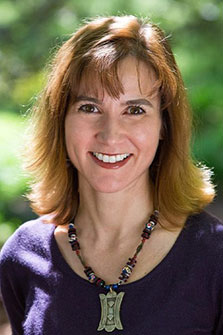 Photo courtesy of Cheryl MoyerCheryl Moyer, PhD, MPH
Cheryl Moyer, PhD, MPH, is a Professor of Learning Health Sciences, Obstetrics and Gynecology, and Health Management and Policy at the University of Michigan Medical School. She is also Associate Director for Education and Mentorship at the University’s Center for Global Health Equity. Moyer has served as an investigator for the Northern Pacific Global Health Leadership, Education, and Development for Early-Career Researchers (NPGH LEADERs) consortium since 2011. NPGH LEADERs is one of six consortia that currently make up Fogarty’s LAUNCH Global Health training program, which supports one year of mentored training for researchers from the United States and low-and-middle income countries.
Why child and maternal health research in Ghana?
My first public health job focused on breast cancer screening in rural eastern North Carolina, where we saw huge challenges in the way providers and patients communicated. There wasn’t always a language barrier, but there were profound gaps in understanding on both sides. When I moved to Michigan, I was pulled into work that was underway in Ghana. One of my mentors, Dr. Tim Johnson, led a program to help establish in-country OB-GYN training, with the goal of increasing the number of practicing OB-GYNs in Ghana. Through the relationships Dr. Johnson and others at Michigan cultivated in Ghana, I got connected to Ghanaian colleagues doing maternal and newborn health research, and the rest is history. I think the thing that is interesting to me now is that when I began my public health career, I had no intention of working globally. Yet in hindsight, the work I began domestically has had a huge impact on the work I do globally. Bridging the gap between patients and providers is a universal challenge.
How do Ghanaian researchers and their western partners relate?
Even early on, our work in Ghana tried to focus on finding the “win-win”, where projects were designed for mutual benefit. Yet structurally, global health has often been driven by western institutions writing grants and then bringing in partners. Today, we’re seeing a growing effort to change that dynamic and support Ghanaian colleagues in leading the research.
For my own projects, I try to make sure my partners are the ones driving the agenda, while I contribute where my expertise adds value. I think Fogarty’s approach to capacity-building and programs like LAUNCH have really helped shift the culture and established long-term networks that are allowing for this shift to stronger and more sustainable partnerships.
Does your current project in Ghana translate to the United States?
My current project is focused on early detection of neonatal jaundice, which is a condition that develops in the first few days after a baby is born. As a baby’s blood cells break down, a bright yellow waste product is created called bilirubin. Too much bilirubin in the blood, which can cause a newborn’s skin and eyes to look yellow, can cause brain damage and even death. If identified early, treatment can be relatively simple. Most hospitals in Ghana have access to phototherapy, the technology used to treat neonatal jaundice. Yet many cases go undetected for a variety of reasons.
To mitigate this, we’re studying a low-cost tool called a “Bili-Ruler” to see if it can reliably help identify babies who need further testing, specifically in children with darker skin tones. The Bili-Ruler allows mothers, healthcare providers, and researchers to compare a baby’s underlying skin tone to a series of increasingly yellow color blocks on the ruler. Lighter colors indicate lower levels of bilirubin, and darker colors indicate higher levels of bilirubin. We are testing to see if mothers’ scores align with healthcare provider scores, as well as if Bili-Ruler scores align with other ways to identify jaundice. Other ways to identify jaundice require expensive equipment (such as using skin-based light refraction via transcutaneous bilirubin assessment, or TCB), or invasive blood tests that may take 12-24 hours to process given laboratory limitations. Our hope is that if mothers’ scores align with healthcare providers’ scores, and if the Bili-Ruler approximates other measures of jaundice, it might be possible to send the Bili-Ruler home with mothers and families to monitor their newborns and improve the chances of early detection in the week after birth.
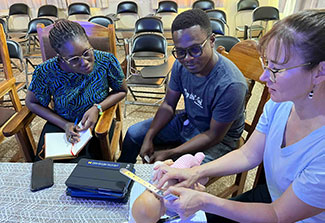 Photo courtesy of Cheryl MoyerMoyer demonstrates a clinical technique for trainees using a doll
Even though this study is happening in Ghana, we deal with challenges in accessing health care in the U.S. as well, especially in rural areas. In my state of Michigan, our upper peninsula has very few healthcare providers compared to the rest of the state, and many residents need to drive for hours to seek basic healthcare. We are also aware of how many of the devices that we use in the U.S. might not work as well among dark-skinned patients. Our study is exploring how well this low-tech, low-cost device works in Ghana, but this information is likely to be useful in the United States as we seek to find tools that work across diverse populations. So, while the context may seem vastly different on the surface, we have a lot more in common than not.
Why is mentorship so important to you?
My focus is always to try and meet people where they are. We all bring different life experiences to our work, and we are all at varying stages of growth. I work to create space for people to process their experiences, especially because in global health research trainees are often navigating unfamiliar environments. If someone isn’t feeling well mentally or physically, they won’t be able to do their best work.
My personal metric for ‘good mentorship’ is if it transcends that initial relationship of mentor and mentee and ultimately helps both of us see the world a little differently. If I can help someone grow, I hope they’ll pay that forward to others. Watching mentees go on to lead their own work is one of the most rewarding parts of my career.
What is your advice for future global health researchers?
Recognize that this work isn’t glamorous. It’s hard. You’ll be far from home, dealing with challenges you didn’t anticipate while simultaneously trying to do complex research sometimes for the first time. Even so, trainees should know that these experiences, whether or not they choose to stay in global health research, will shape them both personally and professionally. Even when it seems like systems are working against you, you can still show up every day, bringing rigor, authenticity, and integrity to the inevitable challenges. For those who stay in global health, the trick is seeing each new challenge as an opportunity to learn something new.
More information
Updated June 11, 2026
To view Adobe PDF files,
download current, free accessible plug-ins from Adobe's website.
Related Fogarty Programs
Related World Regions / Countries