NIH Websites Are Changing
Could solving a Guam medical mystery help explain complex brain diseases?
May/June 2026 | Volume 25 Number 3
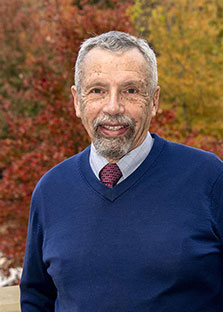 Photo courtesy of Dr. Daniel PerlDr. Daniel Perl
A medical mystery on the island of Guam has perplexed investigators for more than half a century.
In a recent National Institutes of Health lecture, Daniel Perl, MD, posits that renewed investigations of cases of amyotrophic lateral sclerosis (ALS) and dementia on Guam could lead to therapies or cures for patients with related neurological disorders.
Interdisciplinary science, international collaboration, and contemporary technologies, including AI, just might solve this long-standing mystery, suggests Perl, a professor at Uniformed Services University of the Health Sciences.
Singular backstory
Perl begins his lecture with necessary historical context. In 1898, Spain ceded Guam, an island 30 miles long and 4-12 miles wide, along with the Philippines, Puerto Rico, and Cuba to the United States. Shortly thereafter, the U.S. Navy began to rule this U.S. territory in the Western Pacific. On December 8th, 1941—the day after the attack on Pearl Harbor—Japan invaded Guam, which surrendered three days later. The Japanese occupied the island until the summer of 1944, when U.S. troops reclaimed it and began staging the Western Pacific theater of World War II there.
To better understand the island’s endemic diseases (and prevent troop infections), the U.S. Navy set up the ‘Naval Medical Research Laboratory 2’ (later renamed ‘US Naval Institute of Tropical Medicine’). Scientists recruited for the island lab included Harry Zimmerman, a pathologist at Yale University, and Albert Sabin, a virologist at the Cincinnati Children's Hospital. The two shared a tent while working together in the hospital and research facilities (essentially, a series of Quonset huts). Notably, Zimmerman and Sabin developed a vaccine against Japanese encephalitis during their time on Guam.
In June 1945, Zimmerman submitted a monthly report that noted how Guam’s civilian medical wards had admitted seven or eight patients, all Chamorro natives, with ALS (also called ‘Lou Gehrig's disease’). A devastating neurological condition, ALS destroys the nerve cells that control movement, eventually leading to paralysis and death. Guam’s population at the time of Zimmerman’s report was about half of the current count of 169,000 people, with native Chamorro inhabitants comprising half of that total.
Worldwide incidence of ALS is only about 2 cases per 100,000 people, so several cases on Guam would indicate an unusually high prevalence, explains Perl.
Surveys and surprises
After the war ended, the NIH sent two neurologists, Drs. Leonard Kurland and Donald Mulder, to investigate this Guam anomaly. In 1953, they conducted a door-to-door survey of the entire island and discovered the Chamorro population were dying from ALS at a rate 50 to 100 times higher than anywhere else in the world. Their survey documented more than 350 cases in a single village of 700 people.
In some patients, Kurland observed rigidity, bradykinesia (slowed movements), resting tremor, the classic Parkinsonian gait, and a progressive dementia similar to Alzheimer's disease. Notably, these same patients showed a poor response to Levodopa (L-dopa is commonly used to treat Parkinson’s disease movement symptoms). Scientists began referring to this condition as Parkinsonism dementia complex (PDC), with some believing PDC constituted a separate disorder from ALS in Guam. Based on his own research, Perl argues that “it looks much more like a spectrum of disease rather than two separate diseases.”
In 1961, Asao Hirano, MD, a neuropathologist practicing at Montefiore Medical Center in the Bronx, published a series of papers on the Guam ALS cases. His postmortem findings showed prominent upper motor neuron degeneration with lateral cortical spinal degeneration. Kurland sent Hirano’s slides to other neuropathologists, asking, "Is there anything different here?" Perl notes that Nathan Malamud, PhD, a neuropathologist at the Langley Porter Institute at UCSF, answered: "Yes. There are neurofibrillary tangles… and a lot of them.”
Following Malamud’s observation, Hirano looked more closely at his samples and found neurofibrillary tangles in the motor neurons of the spinal cords of virtually all Guam ALS cases. In comparison, he analyzed 50 cases of ALS from his New York laboratory and found no neurofibrillary tangles. Another feature of the tangles in Guam patients is they appear in the superficial layers of the cortex as opposed to the deeper layers, which is the opposite of the distribution seen in Alzheimer's disease. Perl himself has retested samples from this era and found that these tangles are not the beta amyloid deposits commonly seen in Alzheimer’s disease.
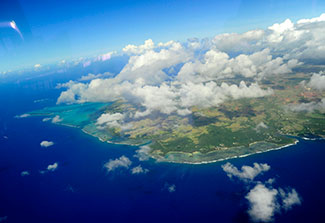 Photo courtesy of U.S. Air Force
Tumon Bay, Guam
Photo courtesy of U.S. Air Force
Tumon Bay, Guam
‘Unusual epidemiology’
Hirano’s findings prompted the NIH to establish a special Guam field office led by Kurland. His team established the mean age of onset for ALS as 46 years and for PDC as 53 years. Of adult Chamorro deaths, 13% were due to ALS, while 11% were due to PDC. At its peak, ALS and PDC together accounted for nearly a quarter of all adult deaths on Guam.
“Now it gets even more complicated,” says Perl. The field office recorded these patterns from 1960 to about 1985, but then “all of a sudden the pathology changes.” Beginning in the late 1980s, more than 61% of the PDC cases began showing amyloid plaques, similar to what is observed in brain specimens obtained from cognitively intact people of comparable age in New York City (and well below what is encountered in moderate or severe Alzheimer's disease).
Adding to the complexity, scientists identified a second locus of ALS/PDC on Japan’s Kii Peninsula. In 1911, Dr. Kinosuki Miora had noted an unusually high prevalence of ALS there and in 1975, Dr. Yoshiro Yase’s follow-up investigation found high incidence of ALS in two villages: Kozagawa had 15 cases per 100,000 people, while Hobara had 55 cases per 100,000. Though these incidence rates are below those seen in Guam, they are substantially higher than elsewhere. Unusually, Kozagawa and Hobara are 125 miles apart and incidence rates in the intervening villages are not high, observes Perl: “So very unusual epidemiology here, but appearing to be a similar phenomenon as Guam.”
More about ALS
In a companion lecture to Perl’s, Maurizio Grassano, PhD, National Institute of Neurological Disorders and Stroke, says ALS confounds scientists primarily because it doesn't look the same in any two patients; some decline rapidly within months, others live for a decade or more.
“ALS is a conspiracy between age, the environment, and genes,” says Grassano, with known genetic factors explaining only a small portion of ALS phenotypic variation—perhaps up to 15%. Both causal genes and modifier variants contribute to ALS’ diverse phenotypes. Some patients carry mutations that powerfully predict how their disease will progress, yet the biology of the mutation itself plays a significant role in disease development. For instance, two patients with an FUS mutation will have different experiences of the disease depending on the location of the mutation—where it sits within the gene; one patient will suffer a rapidly fatal form of the disease, while the other will suffer a milder, slower-moving version.
Grassano notes that a mutation of the C9orf72 gene is associated with a version of ALS that coincides with cognitive and behavioral changes, including problems with thinking, personality, and judgment. Most people with this mutation show some degree of cognitive impairment. In many cases, mental changes occur before physical symptoms.
A New York Times article spotlights the SOD1 gene mutation (occurring in about 2% of all ALS patients) and tofersen, a drug developed by Biogen that targets this gene. When first approved by the U.S. Food and Drug Administration two years ago, tofersen clinical trials showed a reduction in SOD1 protein, which damages neurons; however the trials did not indicate that the drug worked better than a placebo. A more recent study of tofersen found that nearly 20% of 46 enrolled patients showed improvements in breathing, strength, and function. And, while 75% of patients did not stabilize or improve, their decline unexpectedly slowed.
Vanishing act
In the 1980s, incidence of ALS and PDC on Guam began decreasing, while the age of onset increased by 10 years, says Perl. Over time, no new cases appeared on the island, while long-term survivors now account for the few remaining cases.
“Genetic diseases don't just go away like that, and they also don’t change characteristics [age of onset],” says Perl.
Something in the environment caused this disease… and something in the environment— either removal of a harmful agent or introduction of a protective one—made it stop, says Perl. Theory after theory has been pursued—in particular, a toxic plant called cycad, common on the island, has been extensively investigated as a possible cause—yet Perl and other scientists believe none of the explanations suffice. Adding to the mystery, new, high-tech imaging revealed that brain proteins in early Guam ALS samples match those found in chronic traumatic encephalopathy (CTE, the concussion disease most commonly seen in athletes). Despite recent advances in both genetic studies and potential therapies, Guam ALS continues to confound scientists.
The Guam cases show features of ALS, Parkinson's, and Alzheimer's—a “neurological triple threat” unlike anything seen elsewhere, says Perl. If one or more environmental change can eliminate a fatal neurological disease in 30 years, that's not just an oddity, it's a blueprint. To that end, he’s spent decades collecting and preserving samples from Guam patients, which are available for international and interdisciplinary investigations. Perl believes that solving this medical mystery could create the “Rosetta Stone of neurodegeneration” and would lead to an improved understanding of brain disease with profound implications far beyond the island.
More information
Updated June 11, 2026
To view Adobe PDF files,
download current, free accessible plug-ins from Adobe's website.