NIH Websites Are Changing
GEOHealth demonstrates Fogarty's sway, Fogarty's reach
September/October 2026 | Volume 25 Number 5
A single program reveals Fogarty's authority within the U.S. government… and beyond. At the September meeting of Fogarty's Advisory Board, Christine Jessup, PhD, presented Fogarty's Global Environmental and Occupational Health (GEOHealth) program for review. Partners on this program currently include the National Institute of Environmental Health Sciences (NIEHS), the National Cancer Institute (NCI), the National Institute on Aging (NIA), and NIH's Office of Research on Women's Health (ORWH). Prior partners have included the National Institute for Occupational Safety and Health (NIOSH), which is part of the U.S. Centers for Disease Control and Prevention (CDC), and the International Development Research Centre (IDRC), which invests in quality research on behalf of the Canadian government. All partners have made or continue to make financial and intellectual contributions to GEOHealth.
What draws such interest? GEOHealth supports the development of low- and middle- income country (LMIC) institutions to serve as regional hubs for collaborative research, data management, research training, development of curricula and outreach material, and provision of data that can inform health interventions both in-country and around the world. The program, then, addresses an unmet need identified by Fogarty and its funding partners.
 Graphic courtesy of Fogarty International Center
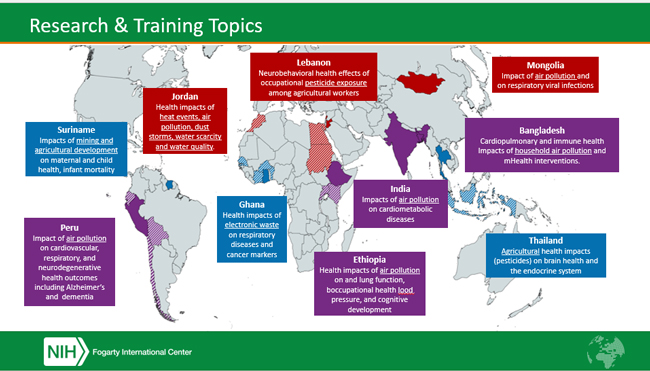
GEOHealth Research Topics by Hub
Rationale, inspiration, and participation
“Environmental exposures threaten human health globally—air pollution, chemical contaminants, household air pollution, extreme weather events—and many of these burdens and exposures cross national boundaries," explained Jessup, a Fogarty program officer. Water and air pollutants travel thousands of miles, impacting neighboring countries and also farther locations. Environmental health challenges are greatest in LMICs, yet these nations often have the least capacity to study and mitigate them.
To address this issue, Fogarty created the GEOHealth program in 2012. Though new, the program was based on a forerunner, Fogarty's International Training and Research In Environmental and Occupational Health (ITREOH) program. ITREOH, which ran from 1995 to 2011, provided research training to hundreds of individuals in 43 different countries. Though it seeded a number of LMIC institutions with expertise, ITREOH failed to build the institutional or regional capacity needed to generate in-country programs or national and international partnerships.
An understanding of the shortfalls of ITREOH informed the development of GEOHealth. Fogarty began by issuing planning grants with help from two partners, NIEHS and NIOSH. Shortly thereafter, NCI and IDRC joined the GEOHealth initiative to help with its full-scale launch, and, subsequently, ORWH and NIA began making their own contributions. At the board meeting, Damali Martin, PhD, MPH, Branch Chief for the Population Studies and Genetics Branch within the Division of Neuroscience at the NIA, shared that “aging populations are increasing in LMICs, and we do feel that global environmental health research helps us to identify modifiable risks and solutions relevant to healthy aging and dementia prevention in the United States.”
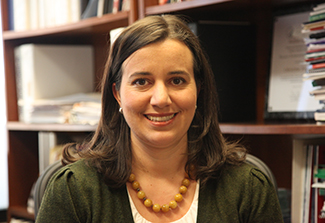 Photo courtesy Christine JessupChristine Jessup, PhD
Funding, structure, and research projects
To date there have been two competitions for full GEOHealth hub awards, said Jessup: “It's important to note that Fogarty has been contributing just a third of the program's $4.2 million annual budget—much of this program is co-funded by our partners." The hubs are unusually structured, receiving paired awards, where the funders finance a research cooperative agreement award to an LMIC institution and a separate but linked research training award to a U.S. institution. In this scheme, the research grant serves as the platform for the training grant and the training activities directly support the research.
“We currently support seven active hubs,” explained Jessup. During the first cycle, GEOHealth funded 5-year hubs in Bangladesh, Ethiopia, Ghana, India, Peru, Suriname, and Thailand. During its second cycle, four of these hubs were renewed and three new GEOHealth hubs were added, two in the Arab region (one based in Jordan, the other in Lebanon) and another in Mongolia.
The hubs have tackled an array of research topics, yet investigations related to air pollution (both indoor and outdoor) are most common. Fogarty has also supported research on mining and agricultural development, pesticide exposure, heat events, dust storms, water scarcity, water quality, and electronic waste.
Looking to the future, Mike Humble, PhD, NIEHS program officer, said that, although researchers tend to study one exposure at a time, people are “exposed to all sorts of things at the same time." NIEHS hopes to explore and examine “the health consequences due to combined effects of environmental exposures, whether it's an infectious agent or a second or third environmental toxicant." Curt DellaValle, PhD, MPH, an NCI program officer, said his institute's interests include “understanding some of the effects of cancer-relevant environmental occupational exposures in LMICs, which have global impact; supporting the scientific training and capacity building that can address our cancer control and prevention needs; helping to build up some of the cancer registries in local and regional LMIC areas; and, of course, translation of a lot of the discoveries in occupational and environmental health to inform cancer control strategies." Senior medical officer Régine Douthard, MD, MPH, expressed her conviction that “this partnership allows us to build on collective strength to advance innovative, sustainable research that improves women's health across the life course, both globally and at home."
In conclusion, Jessup noted that the hubs have produced more than 241 publications to date, where “66% include at least one LMIC investigator as an author and more than half include a GEOHealth trainee as an author." Add to that, more than 30 GEOHealth trainees presented research at the 2026 International Society for Environmental Epidemiology Conference in Munich, Germany.
Following Jessup's overview, Fogarty's Advisory Board, which is comprised of global health researchers, policymakers, and other leaders, agreed that the successful GEOHealth program should be reissued. A Notice of Funding Opportunity is anticipated for 2027.
More information
Updated September 28, 2026
To view Adobe PDF files,
download current, free accessible plug-ins from Adobe's website.