NIH Websites Are Changing
Q&A: Benjamin Chi, MD: Why being in-country matters
July/August 2026 | Volume 25 Number 4
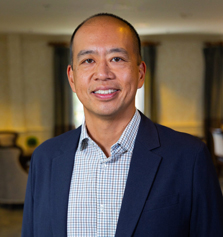 Photo courtesy of Benjamin ChiDr. Benjamin Chi
Dr. Benjamin Chi holds appointments in the Department of Obstetrics and Gynecology and Department of Epidemiology at the University of North Carolina (UNC) at Chapel Hill. Between 2003 and 2015, he lived in Lusaka, Zambia, where he led a research portfolio focused on the prevention of mother-to-child HIV transmission, HIV care and treatment, and maternal and child health. Since returning to the U.S., he has expanded these activities to some of Zambia’s neighboring countries. Dr. Chi leads multiple global health research training initiatives, including the UNC Global Women’s Health Fellowship and Fogarty’s UJMT Launching Future Leaders in Global Health Research Training Program (LAUNCH). Currently, he serves on Fogarty’s advisory board.
Why obstetrics and gynecology (OBGYN)?
When I went through my clinical rotations, the field really resonated with me. I was struck by the idea that you could help women in so many different ways. As an OBGYN there are so many opportunities to help families through clinical care, research, and public health practice. This has also been a consistent theme in my global health work. I've been able to enter new fields of research, such as HIV, that are critical to improving women’s health more broadly.
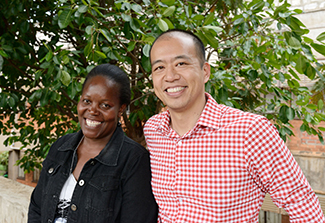 Photo courtesy of Benjamin ChiDr. Margaret Kasaro and Dr. Benjamin Chi
Tell us about your 12 years in Lusaka, Zambia.
After I finished my OBGYN residency in 2003, I had a real interest in research and wanted to develop these skills overseas. I was connected to a program in Zambia and introduced to several faculty who would become life-long mentors. From the U.S., this included Drs. Sten Vermund, Robert Goldenberg, and Jeff Stringer, who remains a mentor and collaborator more than 25 years later. In Zambia, I was privileged to work with the late Dr. Moses Sinkala, who was the district director of health in Lusaka and a graduate of the Fogarty AITRP program. I joined the University of Alabama at Birmingham as a research fellow, with the idea that I might go to Zambia for two—maybe three—years for training.
That decision proved to be life-changing. Soon after our arrival, our group got its first award from the U.S. President's Emergency Plan for AIDS Relief (PEPFAR), which rapidly scaled up HIV care and treatment services nationwide. I had the opportunity to be part of this highly successful initiative, first in the capital city of Lusaka and soon after across four provinces across the country. I began to think about research more broadly, asking questions about how best to implement and optimize services and how to measure their impact at a population level.
The Fogarty International Center played an important role in my career development during this time. I applied for—and was successfully awarded—the K01 International Research Scientist Development award my first year in Lusaka. I designed and implemented a randomized controlled trial of adjunct single-dose emtricitabine/tenofovir disoproxil fumarate to reduce drug resistance associated with single-dose nevirapine use to reduce vertical HIV transmission. Eventually, this was published in The Lancet. The Fogarty K01 award allowed me to extend my time in Zambia and fostered my academic growth at a critical career juncture.
I consider myself very lucky to be in Zambia at that time. Seeing the direct benefit of our work was incredibly gratifying. Since moving back to the U.S. in 2015, I remain connected to UNC’s ongoing work in Zambia. At the same time, I have expanded my research to other places in the region, including Malawi and Zimbabwe.
What was challenging during this time?
A period of such intense activity takes a lot of effort. There was real pressure to roll out services and get things done. It was a period where ‘all hands were on deck,’ with a lot of sleepless nights figuring out how to safely get the first thousand people on antiretroviral therapy (ART) in the first three months of the program. We were all anxious when the first government clinic started to provide HIV treatment, hoping that people would come and that all aspects of care—from clinical exams to laboratory testing to chart documentation—would work as planned. We encountered our fair share of bumps along the way, but we learned from our experiences and successfully rolled out services in places that had never seen ART before. It was a real team effort, with lots of dedicated people making a difference.
What’s your most significant lesson learned?
Being in Zambia full-time, I was able to forge relationships, many that I have to this day. Partnerships are stronger when people know that they can count on you—that you’re willing to spend time in the field and make sure that the work gets done. Thankfully, this approach to global health is much more common now. However, when I first arrived in Zambia, you did not see it as much. More often, people traveled back and forth from the U.S., which can be slow, inefficient, and time-consuming. Opportunities come from being there.
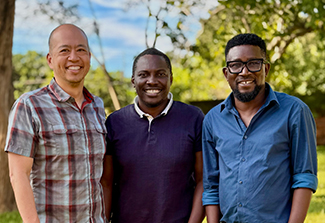 Photo courtesy of Benjamin ChiDr. Benjamin Chi with Dr. Lameck Chinula and Dr. Friday Saidi
Is there any particular piece of advice that you give mentees?
Working with early-career investigators—whether at the student, fellow, or faculty level—has been a very satisfying part of my work.
There is a tendency for mentees, especially those in earlier career stages, to think narrowly about their research interests or the skills that they are looking to build. I recommend a broader approach, looking at each opportunity and what can be learned from it. It might not result in a paper or a grant right away, but it can create platforms for future collaboration. There is also immense value in spending the time to build relationships. These professional networks can be so important and lead to future opportunities, often unexpected.
What spurs your interest in implementation science?
For much of my academic career, I have studied aspects of program implementation, evaluating new services and measuring their impact at a community level. The formal discipline of implementation science is more focused, with frameworks and tools to foster more effective and efficient implementation across different settings. Unfortunately, getting an evidence-based intervention to routine practice is typically slow, often taking years or even decades. How do you shorten that time gap, so that you really deliver on these investments in science? Such implementation science work is exciting and really addresses a need—whether we’re in Zambia or rural North Carolina.
Do you see any new trends in global health research?
Significant changes in global health research are taking place. While immense and immeasurable good has come from US investments abroad, there is a renewed focus on how this work also benefits those in the U.S. This is especially true for rural and remote parts of the country, where people may have limited access to health services.
There is value in fostering connectivity between our work abroad and our work domestically, embracing the idea of what global truly means. We have been building upon the idea of “reciprocal innovation” and incorporating it into our research. We are more deliberate about how we think about shared needs and gaps in healthcare delivery. Importantly, we should consider how lessons learned abroad can improve health locally.
As part of the UJMT LAUNCH Program, we are working with others in this space to highlight how reciprocal innovation is already taking place. We will convene a panel at the annual meeting of the Consortium of Universities for Global Health (April 2026) to show how this has been done successfully across the country and across disciplines. We are also hosting a workshop for LAUNCH alumni—across all seven sister programs—to help these individuals thoughtfully adapt and implement evidence-based interventions from international settings to those in the U.S. Reframing global health in new ways is important and could enhance the impact of such work in the years to come.
More information
Updated August 14, 2026
To view Adobe PDF files,
download current, free accessible plug-ins from Adobe's website.
Related Fogarty Programs
Related World Regions / Countries