NIH Websites Are Changing
A pivot from HIV vaccine research to searching for an HIV cure
March/April 2026 | Volume 25 Number 2
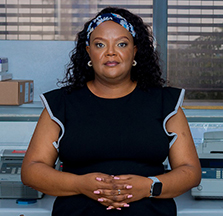
Catherine Koofhethile’s fellowship award from the Organization for Women in Science for the Developing World required her to study for her PhD in a different African country than her home country of Botswana. She chose South Africa for its proximity to Botswana, yet also so that she could remain at the epicenter of the HIV epidemic and affected communities. “I grew up at a time when we could see it happening in our villages. I went to the funerals of relatives and neighbors who lost their lives to HIV/AIDS, because there was no treatment back then.”
Koofhethile’s PhD project at the University of KwaZulu-Natal examined the interplay between HIV and the immune system, a proposal stemming directly from what she’d observed—that some people could control the virus naturally without a need for treatment, while some people could not. The dream of helping to design a vaccine also shaped her hypothesis and project; she wanted her work to identify immune responses that should be elicited by (and included in) an HIV vaccine.
“But then I heard about the Berlin patient who was cured of HIV and I was like, ‘Oh, I need to focus on a cure,’” says Koofhethile.
Chasing a cure
CD4 T cells are immune cells that help clear infections from the body, Koofhethile explains. HIV likes to infect CD4 T cells, which then often die either because the infection causes them to rupture or because of attack by other immune cells. A small proportion of CD4 T cells, despite being infected by HIV, do not actively produce new HIV particles; they go into latency, as scientists say. In these cases, HIV acts as a provirus, meaning it weaves its DNA into the genetic material of the host cell so that when the cell replicates, the HIV provirus passes with it from generation to generation. These sleeper cells are well-hidden, scattered throughout the body, with the immune system unable to recognize (and kill) them and treatments unable to sweep them from the body. This collection of latently infected cells is what scientists call a reservoir.
Koofhethile’s postdoc work, funded by Fogarty’s LAUNCH program, aimed to understand HIV reservoirs as a way of contributing to the development of a cure.
Koofhethile says, “I remembered a cohort in Botswana from a long time ago—the prevention of mother to child transmission cohort. Unfortunately, a small proportion of the babies did acquire HIV from their mothers and soon after birth began treatment.” When she started her project, these children were now teens who’d been taking antiretroviral therapy (ART) for more than a decade. Was it possible, given that they’d started treatment so early and been on it consistently for years, that these teens might be cured?
To answer this, Koofhethile’s experiments induced latently infected cells taken from the teens’ blood samples to see if the inactive proviruses could replicate competent viruses. Despite great hope and strong research, her results showed that the virus in the reservoir—although suppressed and undetectable for more than a decade—could still replicate and cause potentially life-threatening illness.
“I was so disappointed!”
Lemonade
This was not the only setback Koofhethile experienced during her Fogarty fellowship year, which happened to coincide with the COVID-19 pandemic lockdown. “I wasn’t able to go to Botswana to collect samples and I couldn’t work in the lab for a couple of months.” She also contracted COVID, though she didn’t become severely ill. Stuck at home in Boston for weeks on end, she researched and applied for grants. Once lockdown restrictions loosened, she used her Fogarty connections and mentors to start collaborations with nearby organizations. “Collaborators at the Ragon Institute gave me quite a lot of training and work to do.” She worked with scientists there on reservoir analyses in a cohort of infants living with HIV-1 from Mozambique, and generated data and publications characterizing the latent reservoir in the participants. Additionally, she worked on reservoir analysis of specimens which were collected from people living with HIV-2 (a different form of HIV). She also attended “lots and lots of courses” through the Harvard Catalyst Mentorship Program to learn cutting-edge technologies.
Koofhethile’s grant-writing efforts also proved fruitful. Smaller awards enabled her to present her work at different international conferences where she met experts in the field who gave her pointers and advice on how to manage her research. “The data that I generated, the grants that I won, all the thinking that I did at the time—all of it prepared me for moving back to Botswana.”
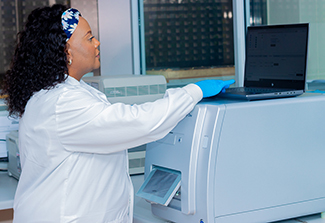 Photo courtesy of Botswana Harvard Health Partnership (BHP) Communications DepartmentCatherine Koofhethile works in her lab
Fellowship outcomes
Her Fogarty year undoubtedly helped establish Koofhethile as a cure researcher, yet once she returned home, she worked hard to advance her research. Her preliminary data from Fogarty enabled her to obtain funding from Johns Hopkins CFAR (Center for AIDS Research) to begin exploring immune responses. She transferred some of the new technologies that she learned in Boston to Botswana and helped train younger scientists to use them. “Trainees on my projects can work without me looking over their shoulder.” She also helped two students obtain Fogarty support.
Another point of pride: Botswana’s government (Ministry of Communications and Innovation) provided some necessary funding to help Koofhethile expand locally while sponsoring trainees. Meanwhile, she applied for and won other awards, including several from the Sub-Saharan African Network for TB, HIV Research Excellence (SANTHE). “Usually these smaller grants contributed to expanding the work, to sponsoring trainees, to setting up the assays, to getting some of the high-level instrumentation that I needed to conduct work in Botswana.” She recently led and won an instrumentation access award from SEEDING Labs enabling her lab to receive a range of equipment.
Importantly, Koofhethile also raised public awareness of the HIV cure research that is done in Botswana. “People previously thought that samples were collected locally but then shipped abroad for research. I’ve shown that we do this work here—we conduct this research here.” And, with help once again from Fogarty, she’s found one other way to put Botswana researchers on the map.
Functional cure
Koofhethile is now in her second year of a five-year Fogarty Emerging Global Leader Award. “A longer-term grant gives you security and lessens a lot of the pressure. You can focus on doing the science.” Her award provides salary support, so she’s diverted some of her funding to her students and to enrollment of a cohort of teens on long-term ART. “I started establishing a cohort once I realized that if you have full control, then you can do anything you want. I can apply for a grant and say, ‘I have the samples, I'm trained, I’ve also trained other people, I have preliminary data to demonstrate that the work is feasible, and I have the cohort to complete it.’”
Long-term ART has the potential to serve as a functional cure for some but not all people living with HIV, Koofhethile says, based on observation of her cohort. Her Emerging Leader research directly addresses this problem. Specifically, she’s assessing the differences in the proviral reservoirs and host cell genetics in the teen cohorts to understand what combination of factors allow some people to control the virus while others cannot. Additionally, she is looking at T cell and Natural Killer (NK) cell responses, which many scientists believe are important for HIV control.
This new research requires Koofhethile to delve more deeply into reservoir dynamics. She is working to identify potential candidates for participation in an analytical treatment interruption (ATI) study. Once she’s differentiated those participants that suppress HIV, she plans to study their reservoirs at three points: before an ATI, during an ATI, and after an ATI. This analysis should help her understand why some people can achieve a functional cure. At the same time, she is seeking to discover simple biomarkers of a functional cure to substitute more expensive scientific procedures when analyzing patient reservoirs.
Significant goal
Going forward, HIV cure researchers will examine combinations of broadly neutralizing antibodies and T cell vaccines to understand whether specific mixes bring greater HIV control, says Koofhethile. “A multidisciplinary, multifactorial approach will get us there, rather than doing things in silos or just focusing on the immunology.”
Meanwhile, Koofhethile advises Fogarty Fellows present and future to “be open minded, be teachable, be receptive to constructive criticism. And don't forget the people who have supported you, like your past supervisors, your primary school teacher, your family.” Go to meetings and conferences and meet the experts, ask them questions (and email them, if necessary). “Allow yourself to be vulnerable in order to grow.” Always, always have a vision board. Koofhethile says, “The ideas are just there every day, and I'm reminded of what I want to do.” As questions come up, you write them down, and when calls come up, you look at your vision board and see what is feasible.
These days she sometimes worries: Will everybody have access if we develop a cure? Still she remains optimistic and focused on her goal. “We can't ignore curing HIV, because there are about 40 million people already living with HIV worldwide.”
More information
Updated April 23, 2026
To view Adobe PDF files,
download current, free accessible plug-ins from Adobe's website.
Related Fogarty Programs
Related World Regions / Countries
Related Global Health Research Topics