NIH Websites Are Changing
Henry Silverman, MD: Brainstorming with AI to generate knowledge
March/April 2026 | Volume 25 Number 2
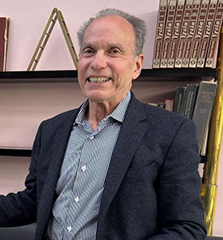 Photo courtesy of Henry SilvermanHenry Silverman, MD
Henry Silverman, MD, a professor of medicine at the University of Maryland School of Medicine, serves as the principal investigator for several Fogarty-sponsored research ethics training programs. His original grant in 2004 focused on Egypt, then in 2014 he extended this program across the Arab Middle East. In 2017, he developed a program for Myanmar, another for Morocco in 2025. Since 2022, he’s served as co-investigator for a Fogarty ethics program in The Gambia.
During the past year, Silverman has organized workshops focused on the ethical use of AI tools in research. “The workshops demonstrate how to use AI tools and how to ensure the trustworthiness of those tools. We also look at which AI tools are best.” Silverman says, “There's a fine line between generating knowledge versus generating content. If you just take, word for word, the AI output, that's content—maybe accurate, maybe inaccurate content.” Generating knowledge requires interacting with AI, challenging the answers it gives you, probing it to attain a richer understanding of a topic. In this sense, responsible use of AI depends on preserving the researcher’s epistemic agency—the capacity to critically evaluate, interpret, and justify the claims being made, says Silverman. “I enjoy brainstorming with AI. When you go back and forth, it can sharpen your thinking and help you develop your own understanding of a topic.”
Silverman sees several ways in which AI tools can enhance research development in lower-resourced regions. There are so many articles published now that it's nearly impossible to do an adequate literature review. “New AI tools find all relevant articles and capsulize the results and findings.” He and his colleagues recently conducted a study of peer-reviewed journals and found that a major reason why some researchers don’t get published is lack of novelty. “If you're not able to understand where the gaps are in research, then your research is not going to advance the field or be exciting,” says Silverman. He adds, there are special AI tools to help investigators recognize the research gap.
AI can also help researchers with their writing by enhancing sentence structure and logical flow. “A peer reviewer sees difficult writing and automatically assumes that the research is no good and rejects it,” says Silverman. He’s developed workshops on scientific writing “that really get into the nuts and bolts. A central element is understanding how the purpose of writing differs across contexts: writing for journals is mainly expository type of writing, whereas for grants, you're trying to persuade somebody to give you money, so that's a different angle.”
Silverman believes he’s fortunate to receive Fogarty funding and feels confident his programs have brought about change and improvements. Former trainees now conduct important research and publish articles, some are chairs or vice chairs on institutional research ethics committees, and many serve in the government overseeing their country’s research ethics enterprise. “When Egypt decided it would be a good idea to have a law regarding research ethics, many former trainees helped develop that law.” One colleague established a network of more than 50 research ethics committees in Egypt. “My plan in Morocco is to develop a diploma and a master’s program in research methodology and ethics, and then build a similar regional network.”
More information
Updated April 17, 2026
To view Adobe PDF files,
download current, free accessible plug-ins from Adobe's website.
Related Fogarty Programs
Related World Regions / Countries
Related Global Health Research Topics