NIH Websites Are Changing
Training hematology researchers and protecting the blood supply in South Africa
September/October 2026 | Volume 25 Number 5
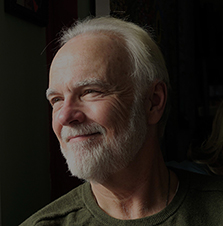 Photo courtesy of University of California, San Francisco Edward L. Murphy, MD, MPH
HIV causes many hematological complications, and so blood transfusion is a crucial resource for patients. It is necessary, then, to develop independent researchers capable of addressing emerging hematological challenges and overseeing blood transfusion safety in the regions they serve.
For nearly two decades, Edward L. Murphy, MD, MPH, professor emeritus at the University of California, San Francisco (UCSF) has worked with the South African National Blood Service (SANBS) and the Clinical Hematology Division of the University of Cape Town (UCT) to train South African researchers who focus on HIV hematological malignancies and transfusion safety. Murphy accomplishes this work through his project, Blood Research and EnhAnced Training against HIV in South Africa (BREATH-SA), co-funded by Fogarty and the National Heart, Lung and Blood Institute (NHLBI).
With a Fogarty supplement, Murphy and his colleagues expanded the BREATH-SA network to include Cape Peninsula University of Technology (CPUT) and University of the Free State (UFS) in South Africa, two institutions with limited funding, research capacity, and infrastructure. Murphy says working with CPUT and UFS helps the BREATH-SA team build capacity “in a more value-added way since they have a lot of unrealized potential. But they’re also excellent partners to SANBS and UCT and provide a stream of bright young people into our program.”
Inverted pyramid
Country-specific data is needed to maintain blood bank quality control and to prevent transfusion-transmitted HIV and hepatitis virus infections. In lower resource regions, a lack of trained researchers has often hampered the gathering of this vital national data. The BREATH-SA team addresses this workforce gap with an inverted pyramid training model, explains Murphy.
The first level consists of short workshops and courses that transpire over five days to two weeks. “Our flagship course is an introduction to clinical research,” says Murphy, noting that the trainees arrive with their research questions in hand. The BREATH-SA team lectures on choosing a study population, selecting methodologies, addressing research ethics, and incorporating statistics, data management, and laboratory techniques. During the course, trainees are mentored as they complete a six-page research protocol based upon their own research question. Next, for trainees who have completed their research project, the team provides a second short course on how to write a scientific paper. "Trainees arrive with their tables, their figures, their charts, and by the end of a seven-day course, they have a first draft of a manuscript,” says Murphy. First level training allows the BREATH-SA team to bring in larger numbers of new trainees while also serving as “a triage point where we can pick out the stars, the ones who can do well.”
The stars move into the second level of the inverted pyramid. Here the BREATH-SA team offers biostatistics courses, further instruction on writing papers, and mentorship training. “It’s tailored to the individual but not degree-level training,” says Murphy. The most capable trainees then move onto the third and final level, Master's degree and PhD programs at UCT or another South African University. “So we take people in at the top of the funnel, and as they work their way to the bottom of the inverted pyramid, we've produced, so far, about a dozen PhDs and 30 master's degree graduates. And a number of them have already gone onto successful careers,” says Murphy.
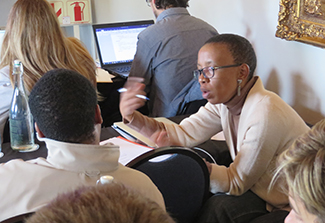 Photo courtesy of Edward L. MurphyTrainees in a short course study epidemiology
Work experience and projects
Often the trainees are young doctors at UCT, CPUT and UFS or doctors, technologists and nurses working at SANBS, which “collects almost a million pints of blood per year,” explains Murphy. This “top-notch” non-profit oversees about a couple thousand employees nationally.
Trainees from SANBS, after earning their Master's degree or PhD (primarily at the University of Cape Town), will often go back to the blood bank, says Murphy. “One particularly successful candidate, Karin van den Berg, got her master's degree through our program, then continued onto her PhD.” She started at SANBS as a physician managing medical issues, then she was “promoted to national Medical Director of the entire blood bank, and now she’s taken a position as Executive Director of the International Society of Blood Transfusion.” Another trainee from the blood service, Marion Vermeulen, earned a PhD through BREATH-SA and is now Chief Operating Officer of SANBS, managing all blood collection, testing, and laboratory operations.
Stateside benefits
To strengthen regional research capacity, the program instructs trainees in running research projects, which examine a range of topics, including HIV lymphoma, HIV-related anemia, HIV-tuberculosis interactions and other HIV-related conditions, since “the focus of our grant is HIV-related hematology,” explains Murphy. South Africa sees a lot of patients with HIV lymphoma, in particular, so lessons learned can be applied in places where HIV lymphoma is less common (including the United States) and where familiarity with this difficult-to-treat disease is low.
At the start of the BREATH-SA program, the team prioritized development of clinical researchers, but over the past five years, they’ve also focused on training laboratory scientists interested in basic research. In the early days of the HIV epidemic, SANBS struggled to collect safe blood across South Africa, so “they've done a lot of research to figure out ways to prevent HIV from getting into the blood supply, which is another major focus of our grant,” says Murphy. One memorable trainee project, by Karin van den Berg, began with unusual clues from routine blood donation testing.
Some people, known as ‘HIV elite controllers,’ have immune systems that make antibodies to the virus (HIV) while their viral loads remain extremely low, explains Murphy. “For these individuals, it's as if they are able to control the virus without antiretroviral therapy.” Lab tests for elite controllers register a positive antibody result with a negative RNA result. “The blood bank was seeing about 10 to 20 of these reactions per year, but, suddenly, beginning about 10 years ago, this pattern had begun to increase. ‘Oh my gosh, we're having more elite controllers.’”
As part of her PhD research, van den Berg sent repository blood samples to UCT, where additional testing proved these were not in fact ‘elite controllers,’ but people with diagnosed HIV who were taking antiretroviral drugs. Additional mixed-methods research helped van den Berg understand why they would try to donate blood despite clear advice to the contrary. Some “just wanted to do something normal for once,” while others caved to peer pressure, because “the blood drive was in their workplace and they felt that if they didn't donate, their colleagues would ask why not,” recalls Murphy. The study resulted in improved pre-donation questions and targeted testing of select donations to weed out HIV positive donations, thereby reducing blood supply risks. This work has also stimulated research in the United States, where blood donors who take preexposure prophylaxis (PrEP) for HIV may pose a similar problem to blood transfusion safety.
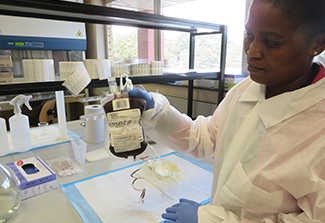 Photo courtesy of Edward L. MurphyTrainee holds a bag of blood donated to the South African National Blood Service
The results of this and other blood transfusion projects have provided far-reaching benefits, notes Murphy. “Close collaboration between my colleagues in San Francisco working in blood safety research and our colleagues in South Africa has helped improve safety in both places.”
Universal issues
As hoped, BREATH-SA has positively impacted South African scientific capacity, producing a safer blood bank and a pipeline of researchers conversant in molecular techniques related to both diagnosis and treatment of hematologic diseases. Bone marrow transplantation is still limited to a select handful of medical centers in South Africa, but BREATH-SA is beginning to make its influence felt even there, says Murphy.
For instance, a former trainee, Kudakwashe Simba, gave the keynote address at a recent conference in Namibia that Murphy attended. “He is a young hematologist who, after a fellowship within our program, moved to Namibia, where he’s become the first hematologist in the country.” Simba established the first bone marrow transplant system in this large but sparsely populated country by organizing “blood collection, the nursing team to support the patient, payment reimbursement … all that stuff. He’s actually done two or three bone marrow transplants now, so he's quite a remarkable young physician.”
All told, Murphy is “super satisfied” with the project and its dedicated trainees. Yet the rewards extend far beyond professional fulfillment. “We can rely on these networks whenever there are emerging problems, such as COVID.” In fact, some on the BREATH-SA team immediately switched gears during the pandemic to work on SARS-CoV-2 antibody surveillance in blood donors. “The establishment of international research collaborations is scientifically important because the problems that we deal with are not national… they're global.”
More information
Updated October 7, 2026
To view Adobe PDF files,
download current, free accessible plug-ins from Adobe's website.
Related Fogarty Programs
Related World Regions / Countries
Related Global Health Research Topics