NIH Websites Are Changing
Arab region researchers aim to understand health in relation to extreme weather
September/October 2026 | Volume 25 Number 5
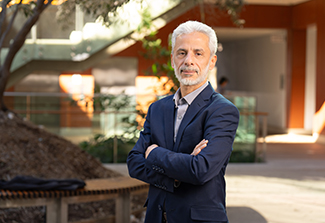 Photo courtesy of University of California, San DiegoWael Al-Delaimy, MD, PhD
In 2017, Wael Al-Delaimy, MD, PhD, found inspiration in an unlikely place. During a Vatican event organized by the Pontifical Academy of Sciences, the late Pope Francis asked the 50 or so attendees representing various fields to actively address the impact of extreme weather events on health. This attention paid by a “high-status entity” to extreme weather made an impression, said Al-Delaimy, a professor in the Herbert Wertheim School of Public Health and Human Longevity Science at University of California, San Diego (UCSD).
“When that meeting finished, I proposed to organizers to write a book about it and almost every person there contributed a chapter.” As the book’s lead editor, Al-Delaimy soon realized that the ground zero of extreme weather events is not the United States but the Arab region. “If we know what's going on there—in terms of heat, in terms of dust, in terms of drought (and low precipitation)—that could help us prepare and know what's coming down the road here in the United States,” says Al-Delaimy.
The book titled "Health of People, Health of Planet, and Our Responsibility" was a great success with a milestone of more than 600,000 downloads of its various chapters. Shortly after the book was published in 2020, he launched a Fogarty-funded project, GEOHealth Hub on Environmental Exposure and Health in the Arab Region-U.S.
A regional perspective
As part of Fogarty’s Global Environmental and Occupational Health program, Al-Delaimy’s project aims to develop Arab institutions to serve as regional hubs for collaborative research, data management, training, curriculum development, and policy support around environmental and occupational health threats. Al-Delaimy applied for GEOHealth funding primarily because the program is built on having two separate but linked components: research and capacity building. This coupling addresses the fact that “the people who are facing a problem may not have the capacity to address it,” while the people capable of providing training may never have confronted a problem directly. The program offers “two-way learning:” United States researchers step in to help train Arab researchers and so gain insight into the health outcomes of extreme weather events.
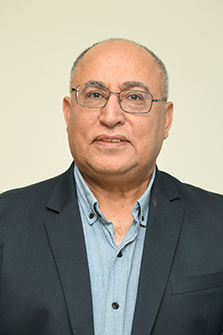 Photo courtesy of Jordan University of Science and TechnologyFayez A. Abdulla, PhD
Al-Delaimy works with a co-P.I., Fayez A. Abdulla, PhD, a faculty member in the Civil Engineering Department at Jordan University of Science and Technology (JUST). “Abdulla and collaborators in two other institutions in Lebanon and Morocco identified the problems and found the relevant existing research and then I helped refine and develop that,” says Al-Delaimy. “We focused on the major problems in the region. So in Jordan, it is mostly water. In Lebanon, it's air pollution. And in Morocco, it's dust.”
To help with funding, the team won a supplemental award to support trainees. Meanwhile, the hub partners assembled mentors, trainers, and faculty across disciplines and across institutions, including Harvard University and University of California, Berkeley alongside UCSD, Mohamed VI University for Health Sciences, University of Balamand, and JUST. “We attracted, interviewed, and then selected promising young people in the areas of environmental health and epidemiology. So far, we’ve trained 43 who are becoming leaders in the region in this area of research,” says Al-Delaimy. Of the 43, three PhD students, two from Jordan and one from Morocco, received training in the United States.
“We have more than 34 master's-level students, many of whom are going to go on and do a PhD… we even have students with bachelor's degrees ready to move onto a master's program,” notes Al-Delaimy. He believes this new generation of researchers will shift the regional paradigm by providing local training. As firsthand evidence of that, 21 members of our GEOhub, who are mostly trainees of the program, participated for the first time as presenters in the International Society of Environmental Epidemiology annual meeting in Munich a few weeks ago. Throughout the past history of the society, usually no more than 2-3 participate from the Arab region in the annual conferences.
As part of its course offerings, the project also developed a graduate level public health curriculum for remote learning. This series includes coursework on geographic information systems and spatial analysis, biostatistics, epidemiology, research ethics, environmental health sciences, occupational toxicology, and research design. In addition, as part of the program goals, over 400 decision makers and graduate students were trained in highly specialized summer workshops, and over 600 attended or presented at the annual conferences. Additional specialized training involved two PhD students participating in a residential summer course hosted by the European Educational Programme in Epidemiology.
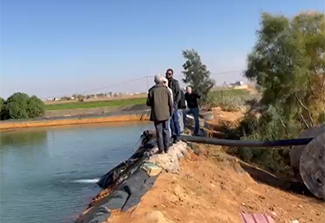 Photo courtesy of Wael Al-DelaimyResearchers surveying a water source in Jordan
Benefits for the United States
While the program undoubtedly enhances regional scientific capacity, it also contributes to and helps to advance scientific collaborations in the United States. Al-Delaimy says, “Harvard University’s Environmental Health Department takes 10 or so new PhD students each year and one of those was our trainee Yazan Alwadi, who studied the cancer risks of living near nuclear facilities in the United States. We bring the best of the best who will eventually benefit themselves, their countries, and the United States.”
Al-Delaimey also notes the importance of the work of "two Moroccan researchers from our program, Younes Tebbaai and Anass Houdou." Tebbaai studies atmospheric dynamics over the Sahara, to understand how these dynamics may help identify future development of dust storms and then develop an early-warning system for dust storms to protect the health of people at risk. Tebbaai understands this “living laboratory” well and is creating an early warning system for dust. Al-Delaimy explains, “We are basically getting all that he’s learned, experienced, knows and talked about with local experts and local meteorologists and scientists in Morocco, and bring it to the United States for us to expand on and learn from and use it.” The work of Tebbaai can be applied to the Southwest region of the United States, where people are exposed to dust storms and blowing dust events, which can cause spikes in respiratory illnesses.
Houdou brings expertise in computer science, data science, and artificial intelligence to develop models of air pollution and disease projections. During his doctoral research in Morocco, he applied machine-learning and deep-learning approaches to predict PM10 concentrations up to five days in advance, with the broader objective of supporting an air-pollution and health warning system. He subsequently joined UC San Diego as a postdoctoral scholar, where he is applying and advancing AI-based forecasting methods to predict precipitation, atmospheric rivers, and flood consequences in the United States.
The “intermixture” of data science, spatial science, computer science, epidemiology, and clinical health is important for modeling and projecting diseases, which “eventually could include mental health, cardiovascular diseases, respiratory illnesses and many other conditions,” says Al-Delaimy. Another example of the importance of the GEOhub is the higher than usual nitrate levels found from a study in underground water in Jordan which is related to drought (and also agricultural run off). “We recently found a 30% higher risk of preterm and/or low birth weight delivery in relation to serum nitrite levels of pregnant women in Jordan. If the United States begins to experience weather events that cause an increase in underground nitrite levels, then scientists and practitioners will be able to identify and protect high risk populations, such as pregnant women consuming such water from underground wells in rural communities.”
Funding ends in a year, meanwhile the team is “well on track,” says Al-Delaimy. Trainees have learned time series modeling to enable them to easily access and use data and partner internationally and they’ve also focused on AI to help them address, collect, and minimize the effort needed to clean datasets. Al-Delaimy says, “Our team is unique because more than half are engineers. They find it much easier to pick up on the modeling, much easier to pick up on machine learning and AI…that is to our advantage. They're learning public health methods and we're learning from them engineering methods as part of interdisciplinary team science.”
Add to that, the project has already produced more than 23 publications in peer reviewed journals with more manuscripts submitted or under review. “A major focus for this remaining year is learning how to create policy briefs for policymakers,” says Al-Delaimy. In fact,
Translation from Research to Policy was the theme of the project’s annual conference, which was held in Amman, Jordan, in late August and attracted the attention and patronage of Her Royal Highness Princess Sumaya bint El Hassan given the importance of this topic nationally and regionally.
Global issues
Al-Delaimy spoke to Fogarty from the conference. “When we are dealing with a problem like extreme weather, we cannot study it within a single country.” He noted that, the United States, which spans a continent and has varied climate patterns, still does not include an area like Jordan, the country with the lowest water access in the world. “I'm in San Diego. We had several years of drought, though not as drastic as in Jordan, but had to cut water use,” says Al-Delaimy. “So how do we save water? Do we recycle water? Do we try desalination? How do we find and use water in ways that will help us sustain our health and livelihood?” Tapping into innovative scientific thinking and ideas in the Arab region today may contribute to plans and policies in the United States in the future, he says.
Al-Delaimy hopes Fogarty continues to support the GEOHub. “We have new ideas to expand on the foundations we have built,” he says. Generally, Fogarty funding is cost-effective for Americans, because the research is done abroad where material costs and salaries are much lower and overhead for research is not nearly as high, he adds. “Global problems need the support of the United States. The benefits down the road far outweigh any of the immediate costs.”
More information
Updated October 6, 2026
To view Adobe PDF files,
download current, free accessible plug-ins from Adobe's website.
Related World Regions / Countries