NIH Websites Are Changing
Focus on HIV
July/August 2026 | Volume 25 Number 4
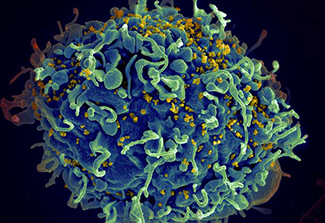 Photo courtesy of NIAID HIV entering a human cell
An estimated 40.9 million people globally are living with human immunodeficiency virus (HIV). HIV, first identified in the early 1980s, damages immune cells and harms the body’s ability to clear infections and diseases. Early treatments were for the infections acquired by people living with HIV and these medications helped to prolong their lives in the advanced stage of HIV (acquired immunodeficiency syndrome or AIDS).
Remarkable scientific progress over four decades has led to the development of effective antiretroviral therapy (ART). ART has transformed HIV, once considered a death sentence, into a manageable chronic condition. When taken as prescribed, ART prevents people living with HIV from passing their infection onto others and allows people, if diagnosed and treated early, to live a normal lifespan. It’s important to note that taking the medication reliably is critical.
One of the recent additions to the ART arsenal is lenacapavir, developed by Gilead Sciences, Inc. over nearly two decades based on early-stage science conducted by academic investigators and research networks funded by NIH. It is approved by regulatory authorities in the United States and many other countries for the treatment of HIV (in combination with other drugs) and for the prevention of HIV (pre-exposure prophylaxis or PrEP). As PrEP, lenacapavir is delivered as a twice-yearly shot.
Many believe lenacapavir is a true “game changer,” says Jared Baeten, MD, PhD, Gilead Sciences. “A twice-yearly option has the potential to change how people experience HIV prevention.” What feels “paradigm-shifting” to Baeten, though, is not the “unprecedented science” but “the opportunity to expand choice and rethink how prevention can be delivered for people and communities that have not always been well served by existing options.”
Beyond ART itself
“We've achieved remarkable success with HIV screening, getting people on ART, and monitoring them,” says Fogarty Grantee Donna Shelley, MD, MPH, New York University. “People with HIV are living longer and developing non-communicable diseases, which are becoming a primary cause of morbidity and mortality in this population. Now the focus is on longevity and a lifespan approach to HIV care,” says Shelley.
In response to effective treatments and strategies, health care systems have begun to change, says Fogarty Grantee Gene Morse, PharmD, FCCP, BCPS, University at Buffalo. “What we're seeing now is the end of specialized HIV care centers (everywhere, really), and the movement is toward primary care and mid-level practitioners.” In short, people living with HIV, once considered “too complex” for primary care, are returning to that setting.
Fogarty Grantee Humberto Lopez Castillo, MD, PhD, University of Central Florida, says he hopes to see a cure for HIV in his lifetime. He adds that he “firmly believes the interventions we have can curb incidence rates at a faster pace than we're already seeing now … both global and local research will get us there.” Meanwhile, he says, “the curve is flattening little by little.”
Gilead's Baeten, a former Fogarty trainee, says, “We have tools that previous generations of HIV researchers and advocates could only imagine. Now we have to do the harder work of making sure those tools reach people in ways that are fair, sustainable, and shaped by the communities most affected.”
Updated August 19, 2026
To view Adobe PDF files,
download current, free accessible plug-ins from Adobe's website.
Related Fogarty Programs
Related Global Health Research Topics