NIH Websites Are Changing
Implementation science helps Vietnam merge HIV and NCD care
July/August 2026 | Volume 25 Number 4
 Photo courtesy of Donna Shelley
Donna Shelley, MD
Photo courtesy of Donna Shelley
Donna Shelley, MD
Donna Shelley, MD, Professor of Public Health Policy and Management at New York University, began her career as a health services researcher. When reading implementation science literature for the first time, she “was immediately drawn to the focus on context—the factors that facilitate or impede implementation. This was largely ignored at the time, despite being core to effectively translating research into practice,” says Shelley, who co-directs NYU’s Global Center for Implementation Science.
Other aspects of the discipline also attracted her. She appreciated the pragmatism of this science, which provides a set of rigorous interdisciplinary methods to close the evidence-to-research gap within a specific milieu. She also liked how it builds evidence around stakeholder engagement and has developed tools to measure the effectiveness of that engagement. Shelley says, “Early on, I’d centered stakeholder engagement in my research because I didn't know how not to—how do you go into someone else's house and start rearranging the furniture without asking their opinion?”
Yet what “really excited” Shelley was that implementation science acknowledges that health care improvement is a dynamic process. “Science isn't static, technology isn’t static. Healthcare workers need the tools to become experts in continuous integration of new evidence, such as when a new clinical guideline replaces an old one.” In this way, implementation science aligns with the emerging discipline of quality improvement science.
For all these reasons, Shelley finds implementation science particularly relevant when integrating HIV and noncommunicable disease (NCD) care, the focus of her current Fogarty project in Vietnam.
Early research
Shelley’s initial implementation science projects focused on smoking cessation in the United States. In 2020, she received a five-year National Cancer Institute (NCI) grant for implementing tobacco use treatment guidelines in HIV clinics in Vietnam. The rising burden of NCDs among people living with HIV (PLWH) was becoming a priority in Vietnam. To address this growing epidemic, the U.S. Centers for Disease Control provided funding for the country to integrate screening for high cholesterol, diabetes, and high blood pressure in HIV outpatient clinics, says Shelley. Working with the national HIV program, her team launched the NCI trial which compared the effectiveness of three tobacco cessation interventions among PLWH. The outcomes of that study suggested national Quitlines, which are “available in 42 low-income and middle-income countries,” could serve as a resource for integrating tobacco treatment into HIV care systems.
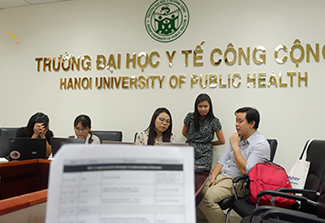 Photo courtesy of Donna Shelley
Trainees work with their mentor at Hanoi University of Public Health
Photo courtesy of Donna Shelley
Trainees work with their mentor at Hanoi University of Public Health
Over time, Shelley’s research expanded beyond testing strategies for implementing smoking cessation to launching a Fogarty-funded program that trains researchers and health system leaders in Vietnam and Laos to use implementation science methods to integrate evidence-based NCD prevention and treatment interventions in HIV care settings. This five-year project, “Advancing Implementation Research Capacity in Vietnam,” leverages Vietnam’s investment in health system redesign to study models of care for PLWH. The country used to have a three-tier healthcare delivery model which included province, district and commune levels. As of 2025, the country eliminated the district level. Shelley explains, “There were outpatient HIV clinics at that level, so now the goal is to implement a care model that integrates HIV screening and treatment along with strengthened NCD care within the commune-level primary care clinics.”
Shelley says, “Vietnam has a new vision for caring for HIV patients that is more integrated and centered in primary care, while improving convenience and continuity of care.”
Trainee influence
Her colleagues at the Hanoi University of Public Health (HUPH) welcomed the opportunity to work together on the Fogarty funded project. Shelley says that with multiple P.I.s—two from HUPH and two from NYU—stakeholder engagement happens from the start of grant development. “As national leaders in implementation science, our Vietnamese colleagues know what type of training matters most to their health care system leaders. We collaborate closely to adapt the curriculum to their needs, and that’s why it works so well.”
Surprisingly, the applicants for her Fogarty project were all high-level administrators with PhDs, even directors within the healthcare system. Her team is training “implementers to do implementation science…what could be more sustainable than that?” Based on these candidate profiles, a new model of her training program emerged, yet it still remains grounded in lessons learned from past projects in-country. Shelley says, “We often start our implementation science training at the healthcare system level, yet we always emphasize the importance of engaging the Ministry of Health to ensure alignment with national priorities and to share program components and results that can inform future training and resource allocation.”
The trainee projects adapt evidence-based programs to the Vietnam context and then test implementation strategies. “The trainees are working on a range of topics including hypertension management programs, mental health care, nutrition programs, and tobacco cessation interventions.” Based on interviews conducted by her team, the new plan to integrate HIV care within the mainstream primary care system will require training to make sure PLWH receive consistent, evidence-based care, says Shelley.
The first cohort of trainees is now submitting articles for publication while the team conducts an evaluation. “We plan to document changes in knowledge and skills to understand how this is affecting trainees’ trajectories as working professionals in the health system.” The fact that none of them are strangers to the real-world system doesn’t hurt. “Our first cohort actively engaged in this transformation of the Vietnamese healthcare system and now they’re trained as implementation scientists, so they’re well-prepared to make a real impact.”
More information
Updated August 14, 2026
To view Adobe PDF files,
download current, free accessible plug-ins from Adobe's website.
Related Fogarty Programs
Related World Regions / Countries
Related Global Health Research Topics