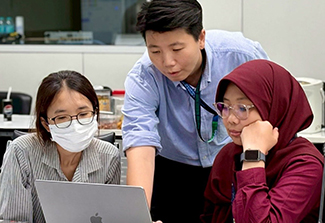
In 2024, Fogarty offered an administrative supplement to help broaden the scientific workforce. The aim was to do a better job of finding and harnessing talent, experiences, and perspectives in the hopes of increasing the likelihood that local research remains relevant and sustainable over time. Fogarty received exceptional applications and achieved its goal of widening the geographic, scientific, institutional, and population scope of its awards.
Read series
The KwaZulu-Natal Autism study focused on identifying children who are autistic in South Africa’s KwaZulu-Natal province. “The opportunity to be part of that established study for my Fogarty project attracted me because it's the area where I spent the first 18 years of my life,” says Lauren Franz, MBChB, MPH, now an Associate Professor of Psychiatry and Behavioral Sciences and Associate Research Professor of Global Health at Duke University.
Read full article
For nearly two decades, Edward L. Murphy, MD, MPH, professor emeritus at the University of California, San Francisco has worked with the South African National Blood Service and the Clinical Hematology Division of the University of Cape Town to train South African researchers who focus on HIV hematological malignancies and transfusion safety. Murphy accomplishes this work with funding from Fogarty and the National Heart, Lung and Blood Institute.
Read full article

Carla Berg, PhD, MBA, a Professor at George Washington University’s Milken Institute School of Public Health and Associate Center Director of Population Sciences and Policy at the GW Cancer Center. Her research focuses on social determinants of substance use, particularly tobacco and cannabis. She’s also examined health behaviors and quality of life among cancer survivors. She’s worked in the Republic of Georgia and Armenia.
Read full article
A Fogarty-funded project aims to strengthen tuberculosis and multi-drug-resistant tuberculosis research capacity in Indonesia, Myanmar, Thailand, and Vietnam. This Global Infectious Diseases program project, which began in 2015, is led by Virasakdi Chongsuvivatwong, MD, PhD, Professor and Curriculum Chairman of the International Program for Graduate Study in Epidemiology at Prince of Songkla University in Thailand.
Read full article
Wael Al-Delaimy, MD, PhD, a professor in the Herbert Wertheim School of Public Health and Human Longevity Science at University of California, San Diego (UCSD), is P.I. on a Fogarty GEOHealth program project that aims to develop Arab institutions to serve as regional hubs for collaborative research, data management, training, curriculum development, and policy support around environmental and occupational health threats.
Read full article
At the September meeting of Fogarty's Advisory Board, Christine Jessup, PhD, presented Fogarty's Global Environmental and Occupational Health (GEOHealth) program for review. Partners on this program currently include the National Institute of Environmental Health Sciences (NIEHS), the National Cancer Institute (NCI), the National Institute on Aging (NIA), and NIH's Office of Research on Women's Health (ORWH). A Notice of Funding Opportunity is anticipated for 2027.
Read full article
Also In This Issue
Print This Issue
The downloadable and printable PDF for this issue will be posted soon.
Subscribe
Subscribe to Fogarty's Global Health Matters newsletter.
Archive
Global Health Matters is produced by the Office of Communications at the National Institutes of Health's Fogarty International Center. For more information about Global Health Matters, please refer to our
Office of Communications page for contact information.
Permission to reprint Global Health Matters content: All text produced in this newsletter is in the public domain and may be reprinted. Please credit Fogarty International Center. Images must be cleared for use with the individual source, as indicated.
Updated September 30, 2026